

Files
Download
Download Full Text (1.5 MB)
Description
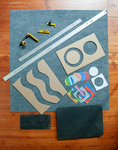
The material that has been essential to many projects is cardboard. Lightweight, sturdy, inexpensive and easy to shape, cardboard is a remarkably versatile material. It can also be seen as difficult to cut. With the right tools and cutting surface, this need not be the case.
Publication Date
1-2026
Keywords
children's art, creativity, artmaking, imagination, cardboard, art tools
Disciplines
Art Education | Early Childhood Education
Recommended Citation
Goldberg, B. (2026). Tools, Mats, and Methods for Cutting Materials. https://educate.bankstreet.edu/partners/14
Comments
This work accompanies the Occasional Paper Series essay "Seeing Meaning"
Goldberg, B. (2014). Seeing meaning. Occasional Paper Series, (31). DOI: https://doi.org/10.58295/2375-3668.1025
All the art in this archive was created by children who were either four years old when the school year began or turned four within the school year. My hope is that the images and texts in this archive will serve as a resource and essential companion to the ideas found in the essay Seeing Meaning. Perhaps, while watching a child paint, a teacher will realize they are seeing a completely other means to making meaning, one that is rooted not in words but in the non-linear pathways of visual imagination, exploration, creativity, and invention. The archived projects are meant to stimulate ideas, as well as provide some practical advice. These are not ‘recipes’ to be followed. They are a point of departure for teachers who recognize visual thinking as something distinct and uniquely important.
Every teacher will approach this subject in their own way— have their own values, level of comfort, desire to explore, and willingness to take risks. They will also have the constraints of space, time, school budgets, and resources to materials, to name but a few. The most important aspect of the archived projects is that they underscore the central theme of Seeing Meaning that children making art are children thinking, using materials as the currency of their thought, and expressing their valuable ideas in the art they create.
Barry Goldberg